
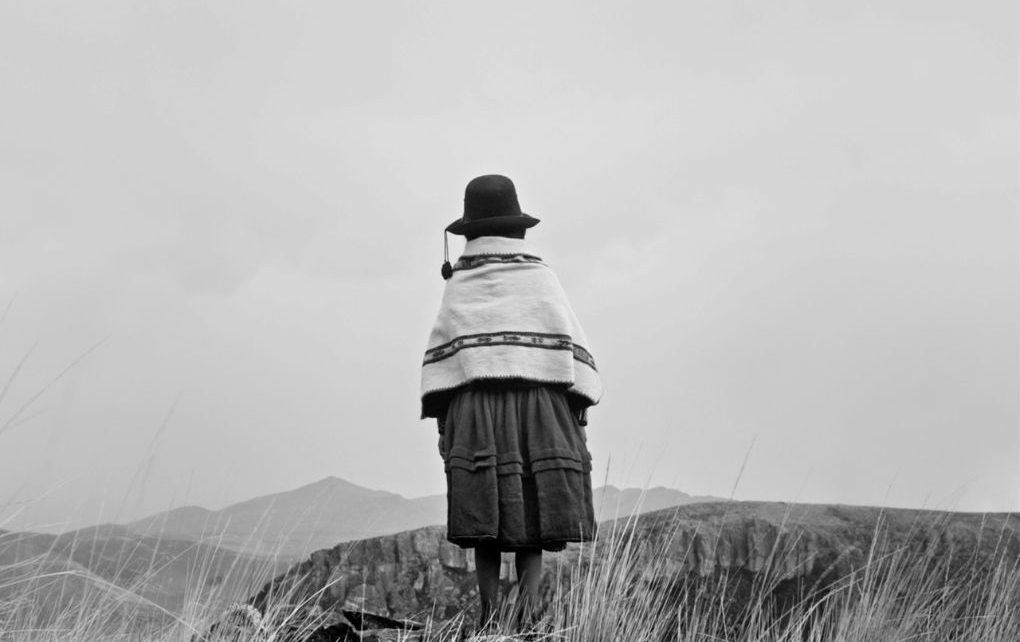
Filmed in the Peruvian Andes with non-professional actors, in the Aymara language, the film Yana-Wara (Óscar and Tito Catacora, 2023) has been compared to a Greek tragedy and the cinema of Ingmar Bergman. If there is any paradox in its supposed “universality,” it does not lie in the film itself but in our perspective, or perhaps in the cinematic artifact as both industry and art within the Modernity project.
Although Yana-Wara interlaces threads from cinema’s masterpieces and its narrative construction recalls the origins of Western literature, it has not received the attention it deserves within the circles that dictate what becomes visible in global film. That is, perhaps, because it resists the paternalistic gaze through which Indigenous peoples are so often portrayed in such fictions. The protagonist, Yana-Wara, an Aymara girl, goes through a series of tragedies that involve the educational system, her family and religion, as well as her vulnerable position as female and minor. The trial of the community that results from these events operates as a narrative device that structures the film and unveils the girl’s experience through the testimony of her grandfather, who, in his efforts to save her, becomes her oppressor.
Seen through the eyes of her torturer, the canonical visuality of Yana-Wara’s martyrdom becomes brazen and, paradoxically, endows the shots with that pure optical affect and that almost ecstatic quality which Deleuze saw in Dreyer’s The Passion of Joan of Arc. In many respects, particularly in the scenes of Yana-Wara’s spiritual treatments, the Peruvian film converses with Dreyer through the close-ups of the protagonist’s face and the ontological realism with which the camera captures pain in its raw state. Yet Yana-Wara’s agony carries no transcendentalism; it does not purify those who contemplate the suffering of the female body, but rather puts them under judgment. Unlike the devout silence of Dreyer’s Joan, Yana-Wara’s (in)voluntary muteness reveals a multilayered trauma and her helplessness before the school, the family, and the religion as a women and a child.
May we push the metaphor further, her muteness points to the difficulty of making the Other’s voice legible through the essentially European and U.S. conventions of cinema. In the prologue to Theory and Practice of a Cinema with the People (Sanjinés), Juan Chimbo, an Indigenous peasant, lamented after watching a film: I was blind, yet I could understand the suffering. With this film, Óscar and Tito Catacora move along that blurred frontier where the reality of pain coincides with the muteness of a character like Yana-Wara or the blindness of a viewer like Juan Chimbo in relation to so-called global cinema.
If films such as Eami (Paz Encina, 2022) erode the conventions of cinema as a device of Modernity to bring us closer to an Indigenous experience—even if elusive to most global audiences—films like Yana-Wara take a different route and prompt us to question whether the spectator can understand an Other’s suffering with the same commitment as that of a Greek heroine.

 Justo Planas