
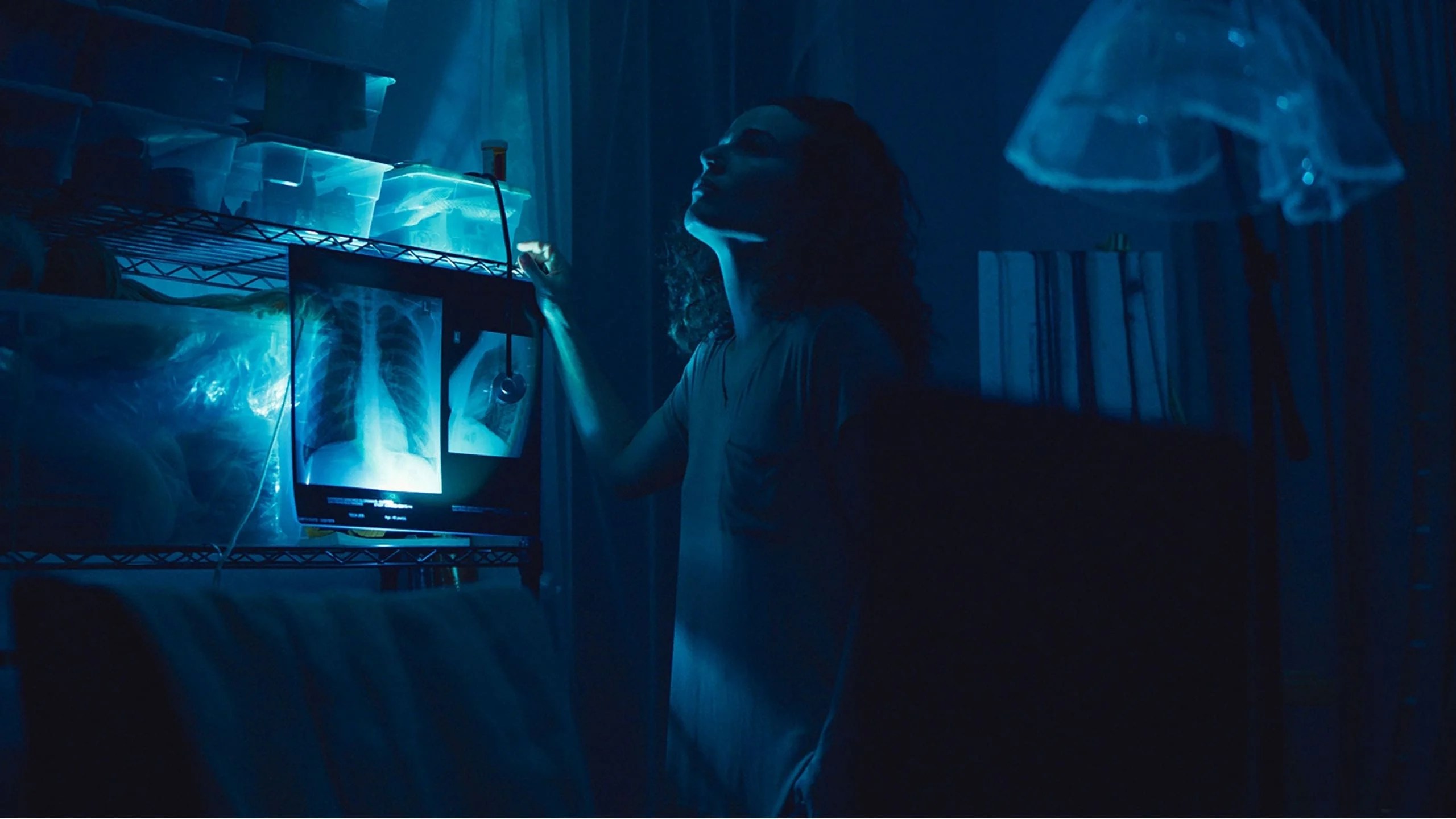
Puerto Rican director Glorimar Marrero’s The Fishbowl (2023) is rooted in the symbolism between the body of the protagonist, Noelia, mined by cancer, and the island of Vieques, contaminated by military waste. The fragile circumstances of Noelia’s sick body—guarded by family members and the medical system for her survival—also mirror those of Caribbean islands themselves, which, as Marisel C. Moreno points out in Crossing Waters, are both connected and isolated by the sea.
Not only is The Fishbowl a narrative of Puerto Rico’s colonial state, but it also epitomizes what a decolonizing film should be in the Caribbean, as it restores to Caribbean sensibility the images and sounds of the islands that hegemonic discourse has turned into stereotypes—visual and sonic landscapes that the North has coined as Caribbean tropes, alienating them, paradoxically, from everyday life: for example, imaginaries of sun and beach, people singing and laughing, as well as hurricanes, poverty, and sickness.
From the time when Columbus crossed these waters, naming islands as the most beautiful, to the recent advertisements by Iberostar, the beauty of the Caribbean exists within specific conventions, just as conventions exist for its ugliness—used, for instance, to refer to cholera in Haiti or the Cuban rafters. Old and new media have transformed these landscapes into a spectacle that, as Jossiana Arroyo highlights in Caribes 2.0, displaces the dynamics of the real. At the same time, our tropical ethos is embedded in sun, beach, laughter, music, and poverty, all of which are part of the experience of any Caribbean individual. These elements, however, emerge dislocated, devoid of true meaning, as they take center stage in the ever-profitable spectacle of the Caribbean.
From the first shot of The Fishbowl, where the protagonist dreams of the sea of Vieques while bleeding in the bathtub of her apartment in San Juan, to the last, where this experience materializes, the search for these subtle Caribbean moments acquires an existential and political significance. The first part of the film explores Noelia’s exile in San Juan—a space depicted as an urban landscape outlined by buildings, buses, and the background noise of machinery. Like a fish out of water, Noelia seeks the sea in conceptual ways: neon blue lights, performances, and photographs. Her acts encapsulate the experience of many in Vieques who had to flee sickness and contamination to reinvent themselves elsewhere. Director Glorimar Marrero does not make grand statements about this; she does not need to, as Noelia’s reality echoes the experience of migrants everywhere.
In Vieques, The Fishbowl transitions from abstract evocations of blue to reveal it in its natural state, while the sound of the sea anchors the shots. Noelia records everything she sees with her phone: wild horses, for instance. “Haven’t you ever seen a horse? They are horses, not unicorns,” someone tells her. But she is perhaps drawn to the ordinariness of the scene rather than its exoticism. Decolonizing in the Caribbean sense is, among other things, about returning the marvelous to its real condition. Many moments in The Fishbowl reflect this. Rum, for instance—a quintessential Caribbean brand—is gifted here in an unlabeled plastic bottle, offered as a form of “caress.”
Perhaps because, for a Caribbean director, making a single film is often a life’s work—Glorimar Marrero spent a decade creating The Fishbowl—, the region’s cinema often delivers reality in heavy-handed doses to audiences, underestimating their ability to read between the lines. Far from this, the (necro- and bio-) politics in the universe of The Fishbowl unfold with cinematic subtlety, enlightening and astounding viewers. For instance, when Noelia moves bags of clothes off her bed to lie down, it becomes clear she is displacing more than fabric: each bag holds the remnants of a life lost to sickness in Vieques, each one a reminder of Noelia’s own destiny as she rests on her bed.

 Justo Planas