
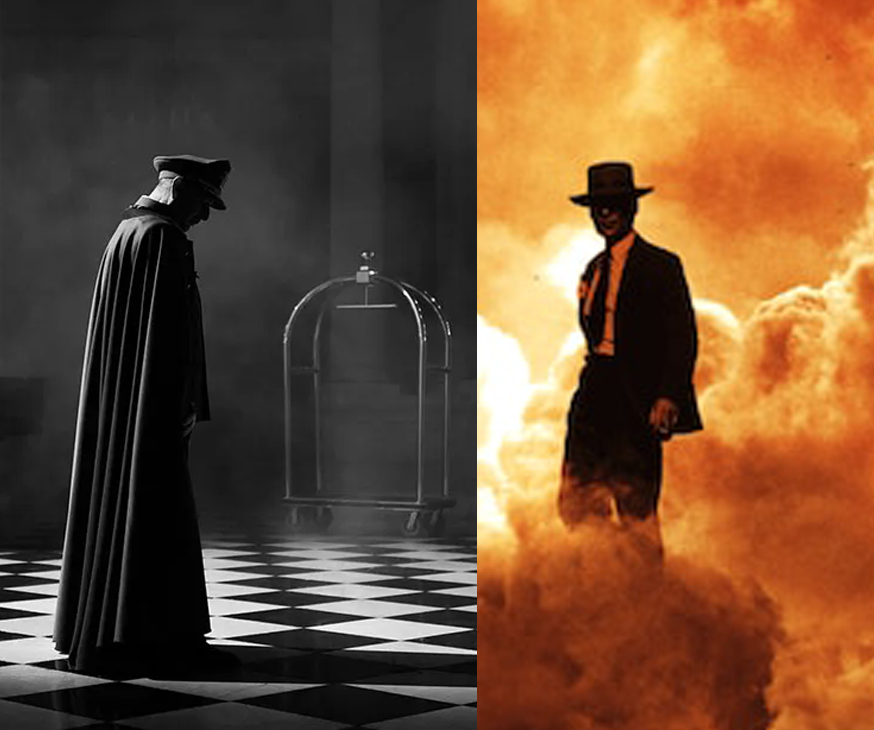
Christopher Nolan’s Oppenheimer (2023) is cut from the same cloth as a masterpiece. Something reminiscent of Charles Foster Kane and Michael Corleone surfaces in the journey of Nolan’s hero. Yet, Oppenheimer’s three-hour struggle in the labyrinth he himself designed could make one feel unease, perhaps indignant, as if experiencing the advances of a longstanding profound past love. Oppenheimer, the creator of worlds, and Oppenheimer, the destroyer of worlds; pharmakon: cure and poison simultaneously, the hero with a thousand faces. Haven’t we seen all this over and over again?
It seemed at some point in the last few years that we were going to turn the page on the cult of the hero-tyrant-monster. The road to filmmaking has been paved with such figures, perhaps starting as far back as Méliès’ Professor Barbenfouillis. Like Joseph Campbell’s profile of the tyrant-monster, Oppenheimer is both a legend and a nightmare, a hoarder of the general benefit, inflated with an ego that is a curse to himself and others, self-terrorized, self-hunted. It appeared that heroes like Oppenheimer would no longer be the subject of adoration, at least in the domain of film. It seemed that other films would have been able to exorcize our imagination and perhaps the real world from men like Oppenheimer.
Haunted by the presence of the late Augusto Pinochet, Chilean director Pablo Larraín released El Conde in the same year as Oppenheimer, 2023. This Latin American dictator, in his own right, could have been depicted with the mystique that tradition dictates, in line with Asturias’ Manuel Estrada Cabrera or Vargas Llosa’s Trujillo. Intertwined with the unspeakable horror in Latin America’s dictator narrative, there is arguably a layer of pride in the men who seize the life of the all-powerful and in the men who read Him marked off within a fiction. However, Larraín’s portrayal of the Count has more to do with Charles Chaplin’s clownish Hitler.
Larraín’s two-decade cinematic journey through the world of Pinochet has led him to this portrayal, from his exploration of the banality of evil in Tony Manero (2008) and Post Mortem (2010) to his discovery of happiness as a tool to move past state symbolic power in No (2012). His biopics Jackie (2016) and Spencer (2021) might also have been formative in understanding the effect of powerful masculine figures on women and vulnerable groups.
Rather than an enticing hero, Larraín’s Pinochet is a weak vampire, thirsty for attention and drained by his wife and offspring. Retired from public life, El Conde is weighed down by the burden of his immortality and the realization that no society could ever fulfill his craving for admiration. Surprisingly, Pinochet’s transformation into a vampire breaks the spell of the tyrant-monster archetype, revealing it as an empty signifier behind which pedestrian individuals hide.
In El Conde, Pinochet is truly a hero with a thousand faces: a royalist French soldier who survives the French Revolution, a progeny of Margaret Thatcher, the master of a tsarist Russian butler. Would it be proper to say that the absurdity and arbitrariness of these connections prove to be anything but absurd and arbitrary? These are all figures that mutually reinforce each other, engendering one another, and serving the common cause of —to put it plainly— a man’s world.
The global framework underlying Claude Pinoche’s metamorphosis into Count Pinochet interrogates not only the foundations of leadership in modern history but also how cinema has served to underpin a specific interplay between men and power. Through the lens of El Conde, Oppenheimer’s involvement with the atomic bomb would have had less to do with a romanticized Dr. Frankenstein and more with the childish ego of Greta Gerwig’s Ken.

 Justo Planas