
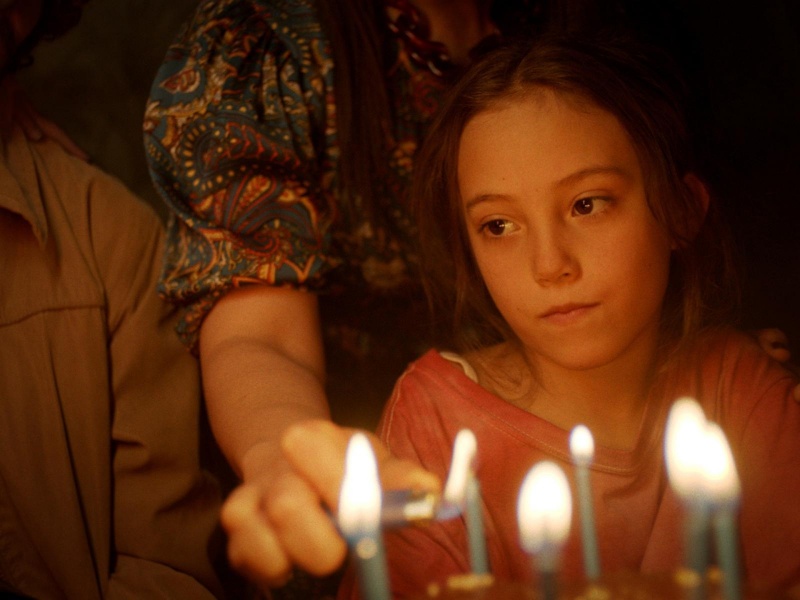
Time flies, heals all wounds, is money, and puts everything in its place. Time is also a totem, and Mexican director Lila Avilés’ Tótem (2023), speaks volumes to the viewer of our time. The film explores some of the latest recurring themes in Latin American cinema, such as notions of home, illness, and childhood. Similar to Avilés, an unusual number of directors have, over the past few decades, turned their focus to these issues. And in Tótem, there exists the theme of the quest for the father in the twilight of all times, a motif immortalized by Juan Rulfo in his novel Pedro Páramo. Its prominence in two impactful recent films, The Box (Lorenzo Vigas, 2021) and Alamar (Pedro González-Rubio, 2010), exemplifies the enduring resonance of this motif within the narrative of Mexican identity. (And, well, there is the everlasting Mexican subject of Thanatos.)
While Totem offers a distinctive cinematic journey through the themes mentioned, the most captivating and intellectually provocative is its depiction of time. In the visual domain, there are highly curated long sequence shots. Narratively, there is the extended wait of the protagonist, Sol, to reunite with her father, Tonatiuh. There is also a sense of disconcertment that accompanies the knowledge of imminent death, especially when it concerns a young person like Tonatiuh, who seems to have much of his life ahead of him. This disconcertment, which likely resonates with all viewers, also permeates Tonatiuh’s family as they prepare for what might be his last birthday. Tonatiuh’s birthday preparations, though outwardly unremarkable, conceal familiar, unsettling human truths that beckon us —almost as if they murmur our names— reminding us the ever-present awareness of our finitude. For example, it is bewildering—ironic, and perhaps even funny—the gift from Tonatiuh’s father to his dying son: a bonsai that he has nurtured for years, and which, as is often the case with trees, will likely outlive both of them and everyone in the house. There is something natural yet sinister in the juxtaposition of the bonsai’s eternity with the brevity of Tonatiuh’s terminal cancer.
The arrival of a medium, brought by one of Tonatiuh’s sisters to cleanse the house’s energies and possibly heal him, reveals another human portal of time: that of the past, that of the passed-away. The medium detects the presence of Tonatiuh’s mother emanating from within a wall. Some kind of experience with the materiality of that wall, while she was still alive, has anchored her presence there, creating a fracture between the present and the past, that serves to protect those who are now in the house— at least that is what her daughter believes.
Taking this into account, Sol’s urgency to reach her father, who is suffering somewhere in that labyrinthine house, can be attributed to her youthfulness and her innocent perception of time’s slowness, an aspect that adults have come to appreciate when it happens. Tótem spans a single day, from dawn to dusk, encapsulating a time-lapse that is more of a human or divine nature, rather than a physical one. Here the Sun, the calendar, and time itself take on the roles of characters. Tonatiuh, the central figure of the Aztec calendar, is a Mesoamerican god and, in Tótem, is a dying father. His daughter’s name, Sol, translates into Sun in Spanish. Her impatience reflects a modern perception of time as a straightforward, unlayered sequence, whereas Tonatiuh’s composure, emerging at twilight to become the party’s focal point, resonates with the Mexicas’ cyclical rhythm—a conception of time intricately weaving together the divine and the natural. It may take some time — perhaps even an eternity — for Sol to come to terms with the idea that death is simply another stage of a life journey.

 Justo Planas