
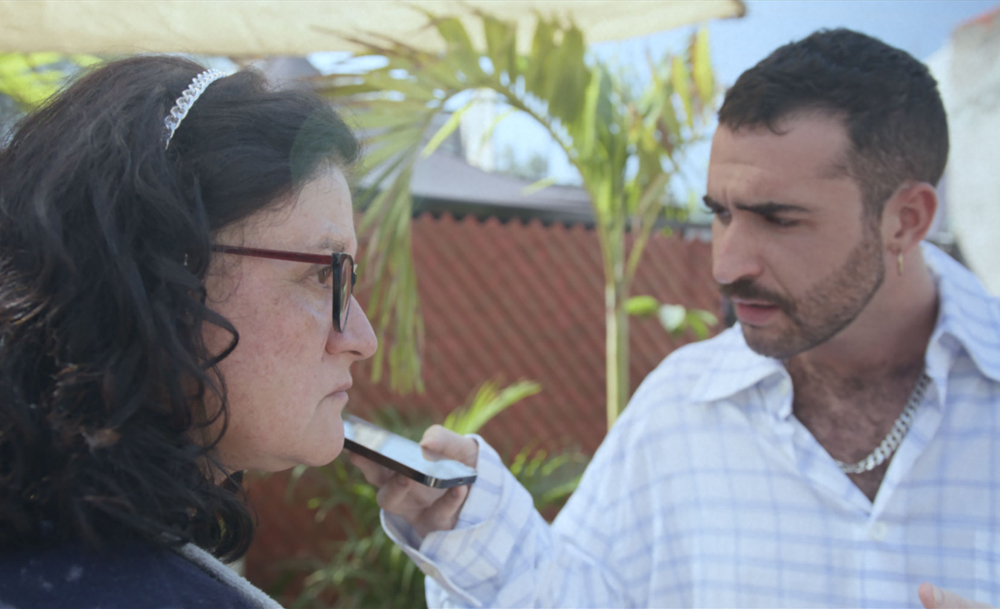
Elisabeth Vincentelli points out in The New York Times that Sebastián Silva’s film, Rotting in the Sun (2023), loses its focus and edge as it shifts from its protagonist’s existential crisis to spotlight the housekeeper. However, something truly defining Silva as a Latin American director lies within this shift, despite the significance of his films within other cinematic frames such as American independent cinema and queer fiction.
It is true that during the first half of the film, Verónica, the maid, is a background character while Sebastián is the main focus. However, this character hierarchy raises suspicion, it is a subtle nod, especially when contemplating Rotting in the Sun within the broader context of recent Latin American films, including Silva’s La nana (2009) and the most praised Roma (2018) by Alfonso Cuarón. It doesn’t take long for Verónica to take the role in the story that the Latin American audience had likely assigned to her from the start, partly due to the similarities between this character and the protagonist of La nana, including the portrayal by the same actress, Catalina Saavedra.
While Sebastián’s existential crisis, drug issues, and contemplations on suicide, sex, and art introduce compelling debates, Verónica’s presence in the background becomes profoundly destabilizing. Similar to the experiences of numerous domestic workers, this character briefly takes the spotlight from her employer when she implores him not to terminate her, reveals that her salary supports a family member’s medical expenses, and asks permission to attend her niece’s quinceañera. It is hard not to consider that the book Sebastián is reading, The Trouble with Being Born by Émile Cioran, would hold significantly different meaning if Verónica were to read it. Verónica and Sebastián not only embody two contrasting philosophies on the complexities of life but perhaps, particularly within the context of recent Latin American cinema, opposing ones.
The interplay between Verónica’s conflicts and Sebastián’s sheds light on one of the paradoxes in Latin American cinema over the past thirty years: the paradox of affluent-class directors portraying the lives of marginalized individuals. This paradox, which might escape notice in other film traditions, stands out in a continent where discussions once revolved around the pursuit of a third cinema, an aesthetic of hunger and an imperfect cinema. This paradox not only lies in the backdrop of several influential films from the 2000s onwards; it has been explicitly addressed by various directors —from Claudia Llosa (La teta asustada) in Peru and Lucía Puenzo (El niño pez) in Argentina, to Carlos Reygadas (Batalla en el cielo) in Mexico and Ian Padrón (Habanastation) in Cuba.
In the case of Sebastián Silva, the narrative transition from Sebastián to Verónica unearths a multifaceted debate about the center and periphery of cinematic representation in Latin America, spanning from aesthetic to ethical considerations. The director does something similar in his film Nasty Baby (2015) in which the character Bishop, an Afro-descendant man grappling with homelessness and mental health issues turns out a Freudian destabilizing force challenging the moral fabric of a narrative primarily centered on characters from a more affluent background. The character Bishop’s heightened significance in the American reception context may be perceived as a betrayal of audience trust, as noted by Mark Dujsik. However, in Latin America, there exists a longstanding cinematic focus on homelessness, as well as very real problems of indigence.
At the very outset of Nasty Baby, Sebastián expresses his obsession with conceiving his own baby —that could be metaphorically a film— that resembles him, an act of perceived selfishness that would hinder him from adopting a child in need. His yearning for self-representation and the self-awareness of the resulting precariousness in others leave him burdened with guilt. He confesses that a price must be paid for his desire. As a result, his art would seek to penalize the ego (egotism, egoism) by constructing scenarios of self-embarrassment.
Similarly, Sebastián Silva’s self-representation in Rotting in the Sun could be understood as an act of self-embarrassment. While the housemaid —a character often voiceless in cinema— moves to the movie’s forefront, the filmmaker’s persona is cast into an abyss, battered against the stairs, and exposed under the sun. Embarrassment, an emotion also employed by Buñuel (Viridiana) and more recently Moreira Salles (Santiago) to depict lives far beyond their own social class, might just be the bridge that connects Sebastián and Verónica, turning them into two facets of the same narrative focus.


